
Why Image Alt Tags Are Essential for Connecticut SEO Success in 2026
When most Connecticut business owners think about SEO, they focus on keywords, backlinks, page speed, and blog content. While those elements remain important, one of the most overlooked ranking factors is also one of the easiest to improve: image alt tags.
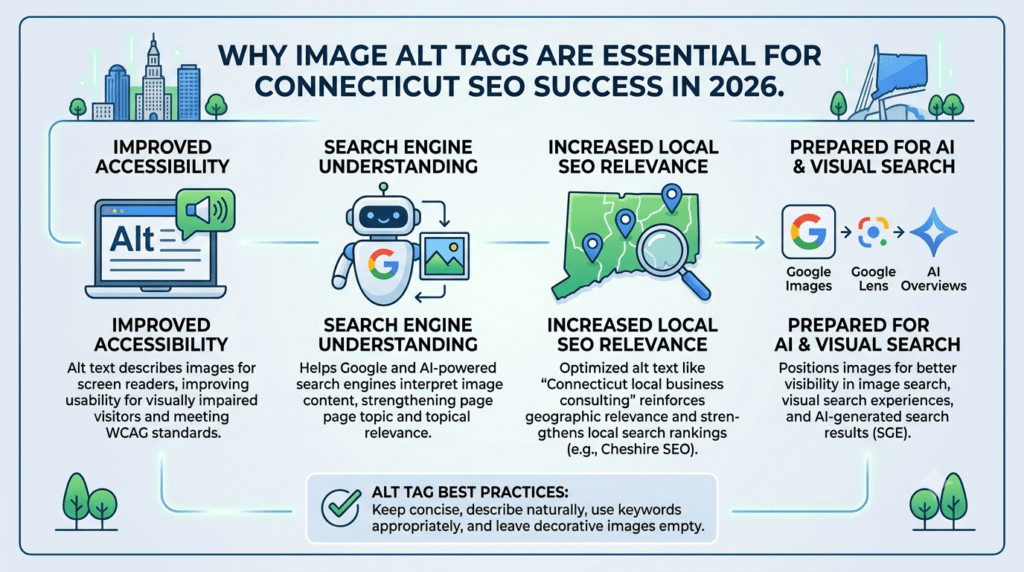
As Google continues investing in AI-powered search, visual search, and multimodal search experiences, properly optimized images have become a valuable part of a complete SEO strategy. Image alt tags not only improve accessibility, but they also help search engines understand your content, strengthen topical relevance, and increase opportunities to appear in Google Images and AI-generated search results.
If your Connecticut business wants to compete for local search rankings in 2026, optimizing every image on your website should no longer be optional.
What Are Image Alt Tags?
An image alt tag, or alternative text, is a short description added to an image within your website’s HTML. Visitors typically never see it, but search engines and screen readers rely on it to understand what an image represents.
For example, instead of using an empty alt attribute or generic text like:
- image1.jpg
- office photo
- IMG_4839
A properly optimized alt tag would read:
“Fresh Online Designs SEO consultant helping a Connecticut business improve Google rankings.”
This tells both Google and assistive technologies exactly what the image contains while reinforcing the topic of the page.
Why Alt Tags Matter More Than Ever
Search engines have become significantly better at interpreting images using artificial intelligence. However, they still rely on descriptive alt text to confirm what an image contains and how it relates to surrounding content. Well-written alt text improves both accessibility and search relevance while helping AI-powered search engines better understand your website.
Today, image optimization supports:
- Google Search
- Google Images
- Google Lens
- AI-powered search engines
- Voice search
- Screen readers for visually impaired visitors
Every optimized image becomes another opportunity to strengthen your overall SEO.
Image Alt Tags Improve Accessibility
Accessibility should always come first.
Millions of users rely on screen readers that announce image descriptions aloud. Without alt text, those visitors may completely miss important information contained within an image.
Proper alt text also helps websites move closer to WCAG accessibility recommendations while creating a better experience for every visitor. Accessibility improvements often align naturally with SEO best practices because both prioritize clarity and usability.
How Alt Tags Improve Connecticut SEO
For local businesses throughout Connecticut, image optimization creates additional local relevance.
Imagine a page targeting:
- Connecticut web design
- Cheshire SEO services
- Connecticut digital marketing
- Google Business Profile optimization
Supporting images can naturally reinforce these topics through descriptive alt text.
For example:
“SEO consultant reviewing Google Business Profile rankings for a Connecticut contractor.”
Notice that the description sounds natural while providing helpful context. It isn’t stuffed with keywords.
This reinforces geographic relevance without appearing manipulative.
Best Practices for Writing Image Alt Tags
The best alt text sounds like a concise description rather than an SEO tactic.
Follow these guidelines:
Describe the Image Naturally
Write what someone would need to know if they couldn’t see the image.
Good example:
“Website designer optimizing local SEO rankings for a Connecticut small business.”
Poor example:
“SEO Connecticut SEO Connecticut marketing Connecticut web design.”
Include Keywords Naturally
If your target keyword genuinely describes the image, include it once.
Never force keywords into images that have nothing to do with them.
Keep It Concise
Most effective alt tags contain roughly 8 to 15 words while accurately describing the image.
Skip “Image Of” or “Picture Of”
Screen readers already identify images.
Instead of:
“Picture of an SEO consultant.”
Use:
“SEO consultant presenting Google Analytics performance data.”
Leave Decorative Images Empty
Decorative graphics that provide no informational value should use:
alt=””
This tells screen readers to ignore them, improving the user experience.
Common Alt Tag Mistakes
Many websites unknowingly hurt their SEO by making simple mistakes.
Avoid:
- Missing alt text
- Duplicate alt text across dozens of images
- Keyword stuffing
- Generic descriptions
- Using image filenames as alt text
- Copying the page title into every image
Each image should have a unique description that matches its actual content.
Don’t Forget Image File Names
Image optimization begins before uploading the file.
Instead of:
IMG_7428.jpg
Rename it to:
connecticut-seo-consulting.webp
Descriptive filenames provide another contextual signal that supports your SEO efforts alongside alt text.
Additional Image SEO Tips
Alt tags are only one part of image optimization.
For maximum SEO value:
- Compress large images
- Use WebP or AVIF image formats when appropriate
- Add descriptive filenames
- Include image captions when relevant
- Use responsive image sizing
- Implement lazy loading
- Add structured data where appropriate
- Optimize image dimensions before uploading
Together, these improvements support faster loading pages, better Core Web Vitals, and stronger search performance.
WordPress Makes Alt Tags Easy
If your website uses WordPress, adding alt text only takes a few seconds.
Simply:
- Open the Media Library.
- Select an image.
- Enter a descriptive Alt Text.
- Save your changes.
For existing websites with hundreds of images, several AI-assisted WordPress tools can help generate first drafts of alt text, although every description should still be reviewed for accuracy and context.
Image SEO Is Becoming Even More Important for AI Search
AI search engines increasingly combine text, images, structured data, and page context when determining which websites deserve citations.
That means your images are no longer just visual elements. They are additional content that helps AI understand your expertise and authority.
Businesses that optimize image metadata today will be better positioned as AI search continues evolving over the next several years.
Final Thoughts
Small SEO improvements often produce significant long-term results, and image alt tags are one of the highest-value optimizations available.
They improve accessibility.
They strengthen local SEO.
They help Google understand your content.
They increase visibility in image search.
They prepare your website for the future of AI-powered search.
If your Connecticut business has hundreds of images without descriptive alt text, now is the perfect time to conduct an image SEO audit. Updating your existing images and optimizing every new upload can improve both user experience and organic visibility over time.
At Fresh Online Designs, we help Connecticut businesses build SEO strategies that go beyond keywords. From technical SEO and image optimization to local search and Google Business Profile management, we create websites that are designed to perform today while staying ready for tomorrow’s search landscape.
Contact us today to take the next step in improving your online presence.