
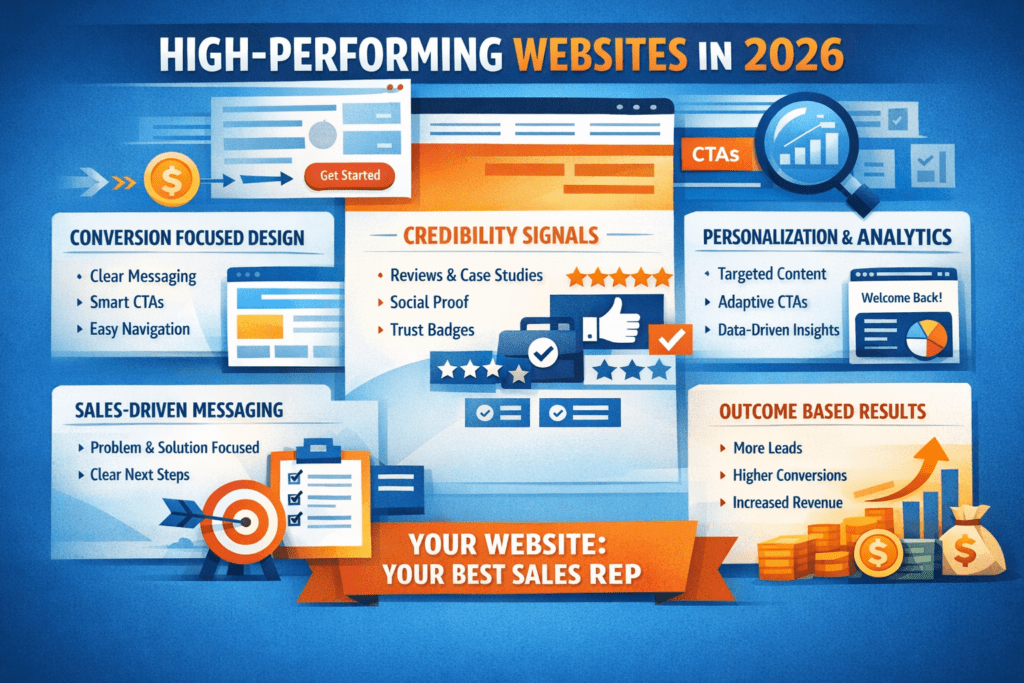
Your Website Is Your Best Sales Rep: How High-Performing Sites Convert in 2026
In 2026, your website is no longer a digital brochure. It is your most consistent, scalable, and cost-effective sales representative. It works 24/7, handles first impressions, qualifies leads, answers objections, and either moves prospects closer to revenue or quietly sends them elsewhere.
For many businesses, that reality is uncomfortable. They like their website. It looks modern. It reflects their brand. But it does not convert.
Here is why that matters now, and what high-performing websites are doing differently.
Why this matters now
Most organizations are being asked to do more with flat or shrinking budgets. Sales teams are stretched. Buyers are more informed, more skeptical, and less patient. The gap between marketing activity and revenue impact is under a microscope.
In this environment, a visually appealing website is table stakes. What actually matters is whether the site actively supports sales by:
-
Clarifying value quickly
-
Pre-qualifying the right prospects
-
Building trust before the first conversation
-
Guiding users toward the next logical action
Websites that fail to do this increase sales friction. Websites that succeed shorten sales cycles and improve lead quality.
What high-converting websites do differently in 2026
High-performing sites are built around buyer intent, not internal preferences.
They start with clear positioning. Within seconds, a visitor understands who the company helps, what problem it solves, and why it is different. There is no clever ambiguity and no generic language that could apply to any competitor.
They are structured to guide, not overwhelm. Pages are designed around decision-making psychology, with intentional content hierarchy, scannable sections, and clear pathways based on user intent.
They remove friction everywhere. Forms are shorter. CTAs are contextual. Navigation reflects how buyers think, not how the organization is structured internally.
Most importantly, these sites are measured and improved continuously. Conversion paths are tested, analytics are reviewed, and changes are made based on data rather than opinion.
Homepage and service page messaging that shortens sales cycles
The homepage has one primary job: help the right visitor self-identify and move forward.
Effective homepages in 2026 follow a simple framework:
-
A clear value proposition above the fold that speaks to the buyer’s problem
-
Supporting proof that shows credibility and outcomes
-
A primary call to action aligned to sales readiness
-
Secondary paths for users who need more information before engaging
Service pages do even more heavy lifting. High-converting service pages are not feature lists. They are sales conversations in written form.
They focus on:
-
The specific problem being solved
-
Who the service is and is not for
-
The outcomes clients care about, not just deliverables
-
Common objections answered directly
-
Proof in the form of case studies, metrics, or testimonials
-
A clear next step that matches buyer intent
When done correctly, these pages reduce the need for basic explanation on sales calls and filter out poor-fit leads before they ever submit a form.
Using personalization, smart CTAs, and analytics to guide users
Modern websites adapt to user behavior.
Personalization in 2026 does not mean invasive tactics. It means relevance. Content, CTAs, and messaging adjust based on factors like traffic source, industry, pages viewed, or stage in the buyer journey.
Smart CTAs replace one-size-fits-all buttons. A first-time visitor may see an educational offer, while a returning user is prompted to schedule a consultation. This aligns the website with how real buyers make decisions.
Analytics play a critical role. High-performing sites track:
-
Where users enter and exit
-
Which pages influence conversions
-
How long prospects take to convert
-
Which content supports revenue, not just traffic
This data informs ongoing optimization and ensures the site evolves alongside the business.
The role of credibility signals in conversion
Trust is a prerequisite for conversion, especially in competitive or high-consideration industries.
In 2026, credibility signals are not optional. They are expected.
Effective websites integrate trust throughout the experience, not just on a testimonials page. This includes:
-
Client reviews and testimonials tied to specific services
-
Case studies that show real outcomes and metrics
-
Logos of recognizable clients or partners
-
Industry certifications, compliance statements, and security indicators
-
Thought leadership content that demonstrates expertise
These elements reduce perceived risk and give buyers confidence before they ever speak to sales.
Contact us today to learn more about how we can make an impact to your online presence.